Reporting obligations and pathways across jurisdictions
Summary of key terms
Reporting pathway: how training activity data reaches STARS, either directly from an RTO or indirectly through an STA.
Reporting obligation: the requirement to report and declare specified training activity data, including the reporting period, validation and data quality requirements that apply.
Assessment scope: the data considered together for validation, data quality assessment and declaration, first separated by reporting pathway and then further defined by the applicable reporting obligation.
Reporting period: the defined reporting cycle for which training activity is assessed and declared.
Jurisdiction: the national, state or territory reporting context associated with a reporting period or reporting obligation.
Reporting pathways
STARS currently supports direct reporting. An RTO submits training activity data to STARS through its Student Management System (SMS).
Future capability
Future indirect reporting pathways will allow RTOs to submit data to an STA, which will then submit it to STARS on the RTO’s behalf.
Reporting obligations
STARS currently only supports training that is not funded by state and/or territories. These national reporting obligations are associated with quarterly reporting periods and national validation, data quality assessments and declaration requirements.
Future capability
Future releases will introduce state- or territory-specific reporting obligations for funded training. Once introduced, the national reporting obligation will cover all VET activity including fee-for-service training and state- or territory-funded training.
Funded training may then contribute to both:
the national reporting obligation; and
the applicable STA reporting obligation.
Assessment scope
An assessment scope is the group of training activity assessed together against the requirements of a particular reporting obligation.
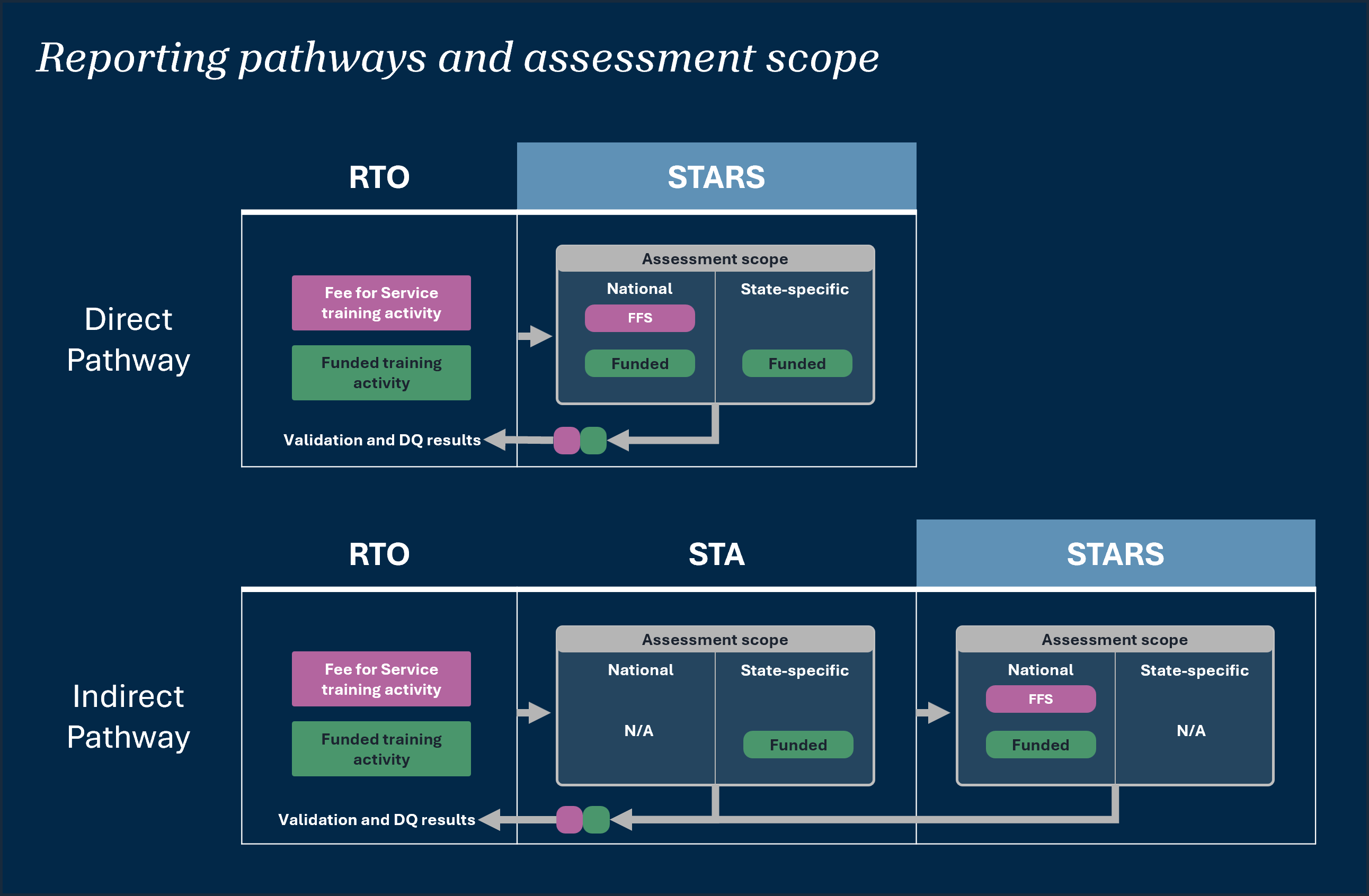
STARS determines assessment scope in two stages.
1. Reporting pathway establishes the broad scope
Training activity is first separated according to how it reaches STARS:
activity submitted directly to STARS forms part of the direct reporting pathway
activity submitted indirectly is separated according to the jurisdiction through which it is reported.
Activity submitted through different reporting pathways is assessed separately.
2. Reporting obligations define the assessment scopes
Within each pathway, the applicable reporting obligations determine which activity is included in each assessment scope and which reporting period, validation, data quality and declaration requirements apply.
A training activity may contribute to more than one reporting obligation. When this occurs, the activity is included in the assessment scope for each applicable obligation.
In simple terms:
Reporting pathway → applicable reporting obligations → assessment scopes
The move from singular to plural is important because one pathway can contain activity subject to multiple obligations, and the same funded activity can appear in overlapping scopes.
How this applies
Fee-for-service activity is included only in the national assessment scope for its reporting pathway.
Funded training activity is included in the national assessment scope for its reporting pathway, and the assessment scope for the applicable STA reporting obligation.
Each scope applies the reporting period, validation, data quality and declaration requirements of its reporting obligation.
The inclusion of funded training in an STA assessment scope does not remove it from the national assessment scope.
Example
An RTO directly reports:
fee-for-service training
training funded by State A
training funded by State B.
For the national reporting obligation, all three groups of activity are included in the national direct assessment scope.
The State A-funded activity is also included in the assessment scope for the State A reporting obligation and assessed against any additional State A requirements.
The State B-funded activity is also included in the assessment scope for the State B reporting obligation and assessed against any additional State B requirements.
The funded activity therefore contributes to overlapping assessment scopes:
a national assessment scope
the assessment scope for the applicable STA reporting obligation.
If activity is submitted indirectly through an STA, it is separated from directly submitted activity before the applicable national and STA reporting obligations are considered.
Reporting periods
Identifying a reporting period
STARS currently supports national quarterly reporting periods for national reporting obligations, assessments and declarations.
National reporting periods align with quarterly reporting cycles and provide the foundation for national reporting obligations, data quality assessments and declarations.
In STARS, a reporting period is uniquely identified by the combination of jurisdiction and reportingPeriodNumber. Always supply both values when an API operation requires a reporting period.
Reporting periods are provided via the reporting period reference data API. Like all reference data API’s, the reporting period includes the business key and the effective from and to values. Given the key for a reporting period is the jurisdiction and reportingPeriodNumber the effective from date is not used. A reporting period will never have two different definitions representing different time windows. The effectiveFromDate will be set when the record is created and not changed.
A reporting period groups training activity into a defined cycle for validation, data quality assessment and declaration.
Future capability
Future releases may introduce jurisdiction-specific reporting periods with different frequencies or declaration requirements. SMS integrations should use the jurisdiction and reporting period values supplied by STARS rather than assume a fixed configuration.
Jurisdictions
A jurisdiction identifies the national, state or territory authority associated with a reporting period or reporting obligation.
Use the jurisdiction value supplied by STARS when calling an API route. Supported enumeration values include national (NAT) and state or territory jurisdictions.
Jurisdiction in API routes
Several STARS API routes use jurisdiction to identify the relevant reporting context.
Example
/reporting-period/{jurisdiction}/{reportingPeriodNumber}
The jurisdiction and reportingPeriodNumber values together uniquely identify the reporting period.
Relationship to assessment scope
A jurisdiction identifies the national, state or territory reporting context for a reporting period or reporting obligation. It does not, by itself, determine the assessment scope.
The reporting pathway first separates training activity according to how it reaches STARS. Within each pathway, the applicable reporting obligations determine which activity is included in each assessment scope and which requirements apply.
Because funded training may contribute to both national and STA reporting obligations, the resulting assessment scopes can overlap. However, activity submitted through different reporting pathways remains separated, even when it contributes to the same national reporting obligation.